Programming Viruses to Fight Pancreatic Cancer With Genomic Intelligence Models
Genomic Intelligence and the University of Minnesota are bringing AI-designed DNA into the development of new anticancer therapies.
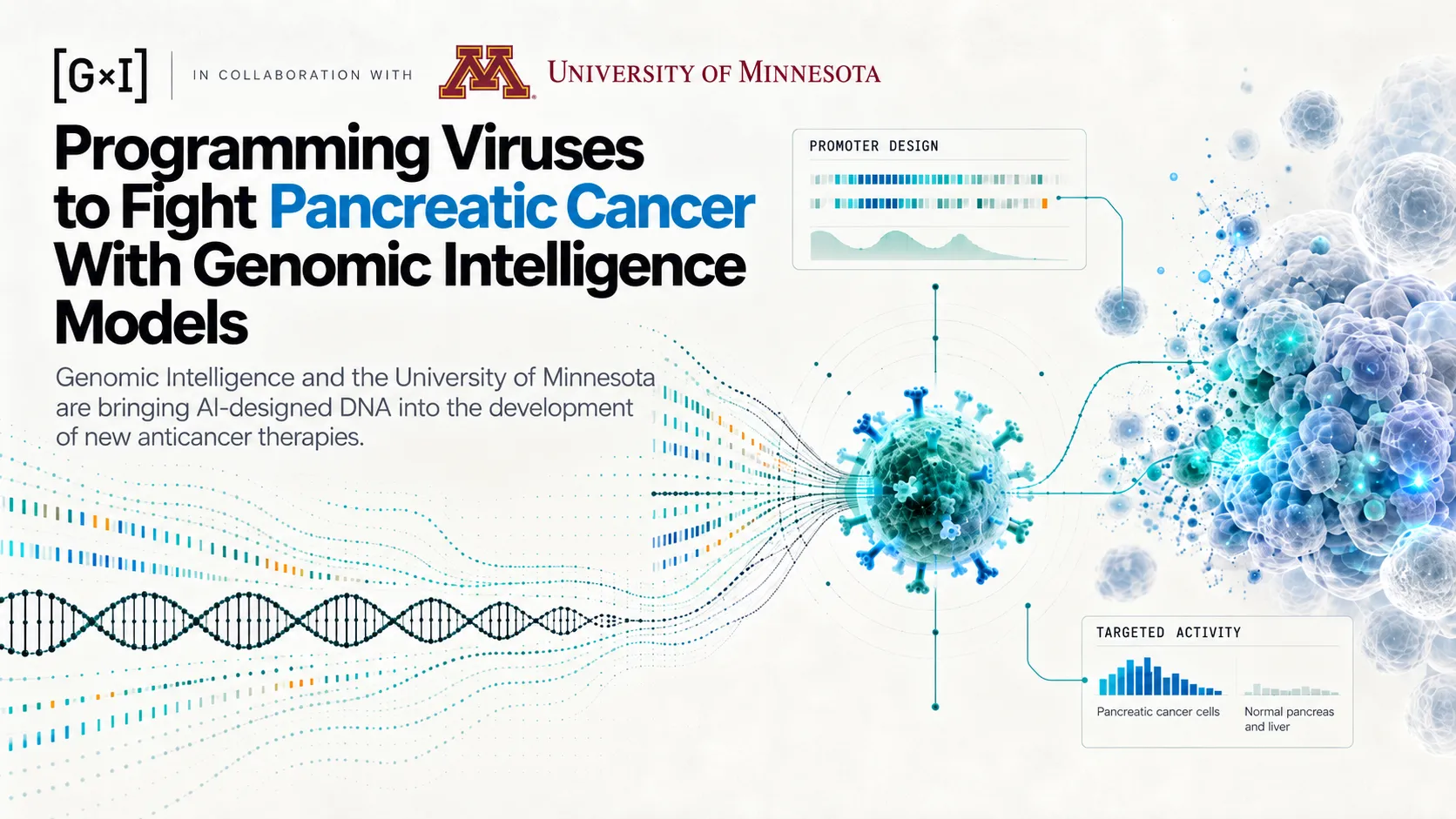
A virus can become a cancer drug by multiplying inside tumor cells and destroying them. It can also help mobilize the immune system against the tumor. But a medicine that reproduces itself presents a demanding design challenge: controlling where it becomes active.
Genomic Intelligence is starting a joint project with Julia Davydova’s laboratory at the University of Minnesota to address that challenge.
Our initial focus is pancreatic ductal adenocarcinoma, or PDAC. The goal is to design regulatory DNA that supports strong activity in malignant cells while limiting activity in normal pancreas and liver, advancing candidates for new oncolytic virus therapies.
Designing the control system
At the center of this work is the promoter, a stretch of DNA that helps determine when a gene switches on. In a therapeutic virus, promoters can help control the genes needed for replication.
Davydova’s team has already demonstrated this principle: earlier preclinical research showed selective replication in human pancreatic cancer specimens, with limited replication in normal tissues. That work provides an experimental foundation for the collaboration.
Genomic Intelligence’s contribution is to make these control sequences a designed component of the drug. With our Promoter Atlas product, researchers specify the activity they need, and the platform returns ranked promoter sequences with predicted activity profiles. Researchers can then synthesize and test those sequences.
For a therapy developer, the intended benefit is a more focused set of experiments and fewer rounds of searching for a suitable regulatory sequence.
From patient data to experimental validation
The design work will draw on molecular profiles of patient tumors. Single-cell datasets let researchers distinguish malignant cells from the immune and supporting cells around them. Samples from primary tumors and metastases will help us look for biological programs shared across different manifestations of pancreatic cancer.
Separate tumor cohorts will help assess how widely those programs occur, while pancreatic and liver reference data will inform the activity we want to avoid. This matters because a useful therapy must account for the diversity of real tumors.
Minnesota’s experimental expertise will connect those predictions to drug development. The pilot will test whether candidate promoters behave as intended in relevant biological contexts and identify promising designs for further preclinical evaluation. This lab-in-the-loop will also feed experimental findings into subsequent designs, building evidence about what works inside a therapeutic construct.
Computationally designed DNA as part of the medicine
For Genomic Intelligence, the opportunity begins with design programs that help biotechnology companies develop better therapeutic candidates. Successful validation could support licensing regulatory sequences and co-developing therapies. The same design platform could extend to breast cancer, neuroblastoma, and other indications, with each program contributing new evidence to improve future designs.
The ambition is to make computationally designed DNA part of the medicine itself: a control system built around the cancer being treated and the healthy tissues that must be spared.